Owners ask whether to hire a trivia host the way they ask whether to outsource bookkeeping — usually with a guess, rarely with the math. The DIY route saves $150 a night. The hosted route saves your nights and weekends. Both can be right. The wrong answer is the one you picked without doing the calculation.
Below is the real spreadsheet, both options, with the break-even line.
What you're actually paying for with a hired host
The $150 host fee in most US markets buys four things, only one of which is "the show":
- Question content: the host service writes or licenses 40+ questions per week.
- The on-mic talent: the actual hosting — reading questions, working the room, holding 90 minutes of attention.
- Audio and projection setup: hosts who travel with their own gear save you the equipment investment.
- The brand pull: hosts with a regional reputation bring teams who follow them between venues.
If you DIY, you're absorbing all four. The first one (content) is cheapest to outsource — a $14.99 themed pack or a $0.99 weekly subscription replaces 4 to 6 hours of writing. The fourth (brand pull) is the most expensive to replicate without paying a host.
The annual P&L: hosted vs DIY for a 50-seat bar
Holding everything else constant — same room, same Tuesday slot, same six-week ramp — here's what the year looks like at maturity (week 12 onward):
| Line item | Hosted ($150/night) | DIY (bartender host) |
|---|---|---|
| Annual gross sales lift | $66,000 | $59,000 |
| F&B COGS (30%) | -$19,800 | -$17,700 |
| Host fee (46 weeks) | -$6,900 | $0 |
| Bartender bonus / shift comp | $0 | -$1,840 ($40/night) |
| Question pack / subscription | $0 | -$50 (annual sub) |
| Prizes | -$2,300 | -$2,300 |
| Equipment amortized (3 yr) | $0 | -$130 |
| Net contribution | $37,000 | $36,980 |
That's not a typo — the net is roughly the same. The hosted path generates more gross sales (better hosts pull bigger crowds) but costs $5,000-plus more in fees. The DIY path has lower gross but higher margin per dollar of revenue.
The real difference shows up in two places that don't appear on the P&L: your time, and the risk of a bad night.
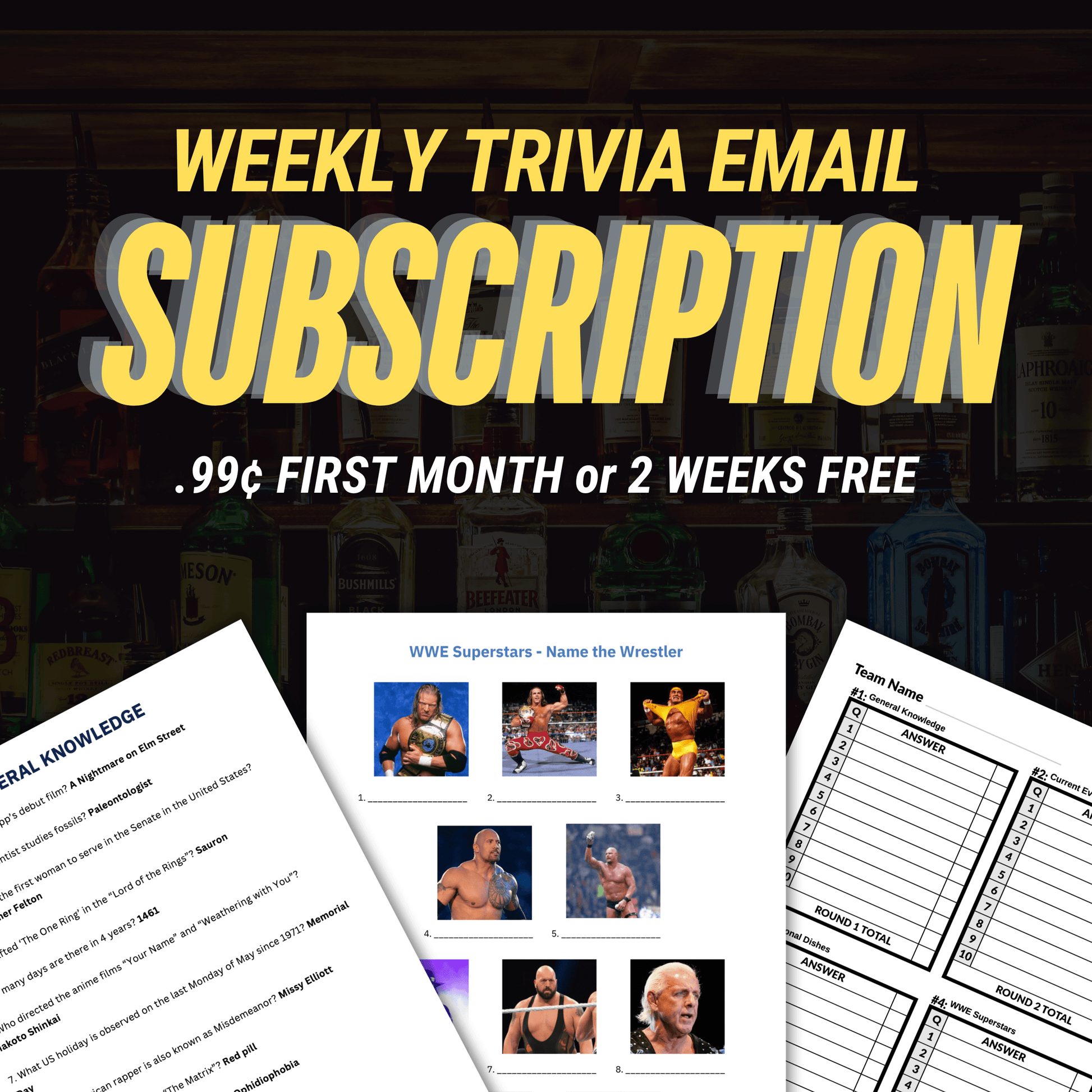
Weekly Trivia Subscription Service
The DIY route lives or dies on having good content every week. A weekly subscription drops a fresh, host-script-included pack in your inbox each Monday for less than the cost of a beer.
The hidden costs of DIY (that nobody puts on the P&L)
The spreadsheet above gives DIY a slight edge. The full picture is more complicated.
- Owner time: if you're the host, that's 8 hours a week (prep + setup + run). At $50/hr opportunity cost, that's $20,000 a year of unpaid labor.
- Single-point-of-failure risk: if the bartender host quits, calls in sick, or gets sloppy by week 30, your trivia night dies. A hosted service has backup talent on a roster.
- Ramp variance: a competent hired host can pull 25 players in week one. A first-time bartender host might pull 10 players in week one and 12 in week three before things click.
- Energy drain: hosting is performance work. Your bartender's tips suffer the night they host because they can't run the rail at the same time.
If you adjust for owner labor at $50/hr (a conservative number), the DIY annual net drops to around $17,000 — well below the hosted scenario.
The decision framework: which one fits your venue?
Use this framework. If three or more of these apply, you should DIY:
- You or a salaried manager already work Tuesday nights and have spare bandwidth.
- You have a charismatic staff member who genuinely wants the gig (and the bonus).
- Your bar is under 50 seats and you don't need huge crowds to make trivia work.
- You're price-sensitive on month-one cash burn.
- You like being on the floor and want a reason to be visible to regulars.
If three or more of these apply, you should hire:
- You're 60+ seats and need a full-room crowd to justify the slot.
- You don't have a staff member who can MC without freezing.
- You're already running thin on Tuesday staffing and can't afford to take a bartender off the rail.
- You want trivia to launch in a downtown market with existing trivia competition.
- Your time is worth more than $40/hr to you.
Hybrid: DIY with a content service
The third option most owners don't consider: DIY the hosting, outsource only the content. This is what the smart 50-seat brewpub on a budget actually does.
Cost structure: $0 host fee, $50/year for a weekly question subscription, $40/night bartender bonus. Total annual variable: roughly $1,890. Net contribution: $37,000-plus, with no questions to write.
This is the move that most owners under-rate. The reason DIY trivia fails 80% of the time isn't the hosting — it's the content. Bartenders who Google trivia questions the night before deliver inconsistent difficulty, recycled questions, and no picture round. Buying the content closes the quality gap to about 90% of a paid host's show, at 5% of the cost.
The break-even point: when hiring is mandatory
Hire a host the moment one of these three things is true:
- Your venue is bigger than 80 seats and you need 50+ players to fill it.
- You DIY'd for two months and you're stuck under 20 players.
- You can't find a staff member who genuinely wants to host and is good at it.
The math also flips for restaurants where the average ticket is north of $35. At those tickets, even a 20% headcount lift covers the host fee with room to spare.
What to ask a host service before you hire
If you decide to hire, the host service you pick matters more than the math suggests. Ask these five questions before signing:
- Can I see a host work a room before I commit? Reputable services welcome this.
- What's the backup plan if my host can't make it? A real service has a roster of subs.
- Is there a contract minimum? Avoid 12-month locks for a first-time program.
- Who provides the audio gear? Some services bring everything; some expect you to have a PA.
- Do they have an exclusivity clause? Some national brands won't let you market the event without their approval. Read carefully.
The honest answer most owners don't want to hear
If you're asking the hire vs DIY question, you're already further along than most owners — who just default to whichever path they hear about first. The math says: small bars with a willing in-house host should DIY with bought content. Bigger bars and busy owners should hire. Everyone else falls somewhere in the middle and should pilot both for a quarter each.
What kills trivia night is none of this. It's quitting at week six.