Trivia night is the highest-ROI weeknight programming you can run in a bar. The setup is simple. The execution is where most owners get it wrong — usually by under-investing in audio, picking the wrong night, or burning out their staff with a format that doesn't pace.
This guide is the complete playbook. Every decision laid out, with the answer that works for the average 50-to-80-seat bar in a US college town or near-downtown neighborhood. If your venue is wildly different, you'll still want to read it — the framework holds.
Step 1: Pick the night before you do anything else
Tuesday or Wednesday. Almost always one of those two. Here's why:
- Monday: too quiet. Players are tired from the weekend. Most markets see Monday trivia struggle to break 15 players.
- Tuesday: the prime trivia night in the US. Bars that run Tuesday trivia consistently outperform every other weeknight slot.
- Wednesday: the strong second choice. Slightly higher headcount than Tuesday in some markets, particularly downtown.
- Thursday: trivia competes with happy hour, date night, and pre-weekend dinner crowds. Average ticket is higher; headcount is harder.
- Friday-Sunday: almost never. You don't need trivia to fill weekend nights, and the format kills bar turn.
Walk your block. If three other bars within four blocks already run Tuesday trivia, take Wednesday. Trivia regulars are loyal but not infinite — you don't want to fight a turf war for the same 60 players.
Step 2: Decide whether you self-host or hire
This is the single biggest cost decision you'll make. The answer comes down to whether you have a staff member who can hold a room.
| Approach | Cost per night | Setup time | Best fit |
|---|---|---|---|
| DIY with bartender host | $15-50 (content + prizes) | 3-4 hours per week | Owner-operators, small bars under 60 seats |
| Hosted service (local) | $150-200 host fee + prizes | 30 min per week | Bars that want zero operational lift |
| National hosted brand | $200-350 + revenue share | 15 min per week | Multi-location, brand recognition |
If you have a charismatic bartender or assistant manager who can comfortably MC, DIY is the right answer. If you don't, don't fake it — bad hosting is the single fastest way to kill trivia night dead. We covered the full math in our DIY vs. hire ROI breakdown.
Step 3: Buy the right equipment (don't over-buy)
You need three things: a way for everyone to hear the host, a way for everyone to see the picture round, and a way to keep score. That's it.
Audio
A wireless handheld mic and a powered speaker is the right answer for most bars. A Shure SM58 wired to your existing PA is the cheap version. Don't trust the room's house music speakers — they're rarely loud enough at the back wall, and feedback is a constant risk. Total spend: $200-450.
Display
A 50-inch+ TV with HDMI input and a laptop. Picture rounds, intro slides, and team standings all run from a PowerPoint. The $14.99 packs from cheaptrivia ship with a ready-to-project PowerPoint, which is what most owners use. If your bar has multiple sightlines, a second TV mirrored is worth the $300.
Scoring
Paper answer sheets. A clipboard for the host. A spreadsheet on the laptop for running totals. Avoid app-based scoring for the first three months — it adds a tech failure point you don't need.
Weekly Trivia Subscription Service
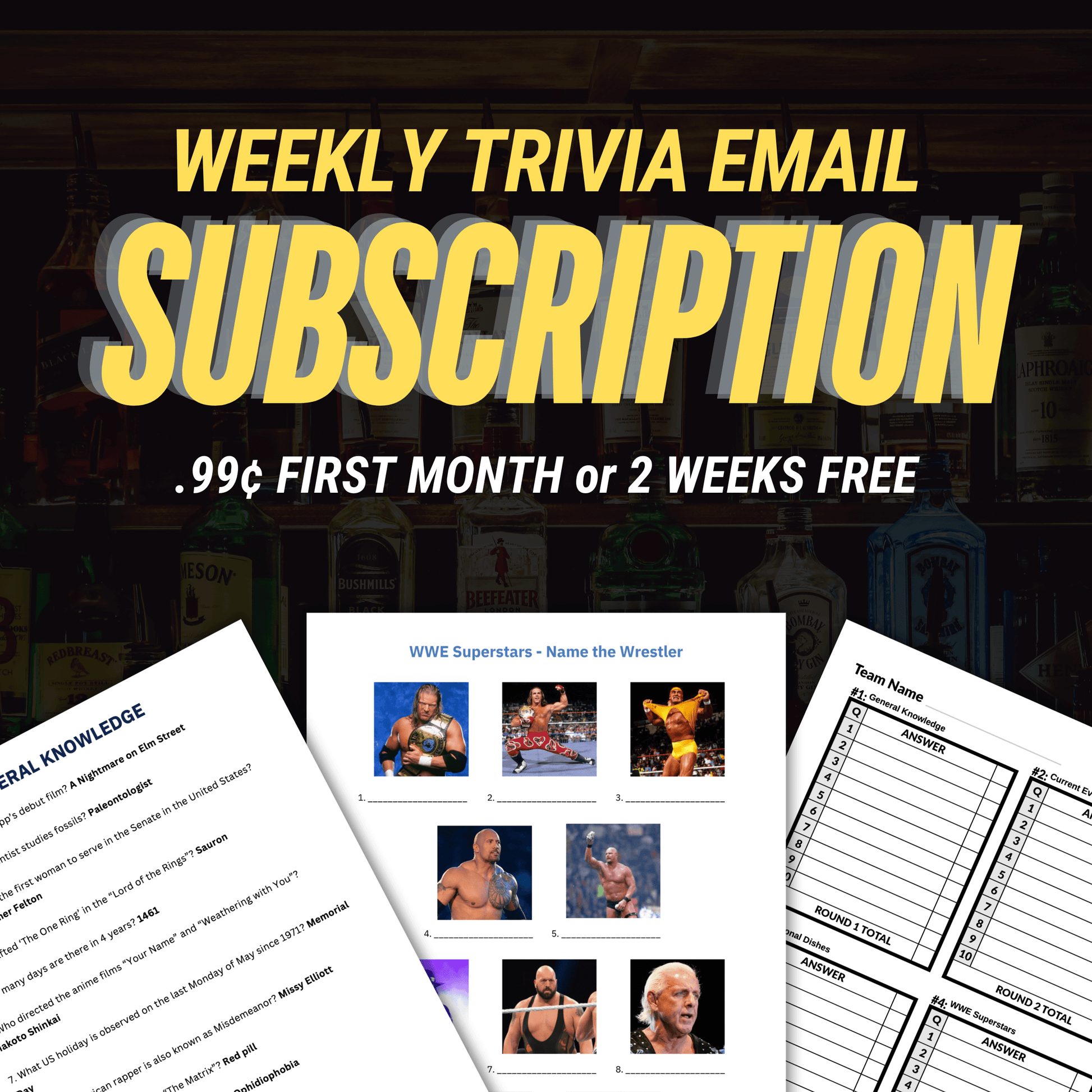
Skip the four hours per week writing questions. A fresh pack lands in your inbox every Monday with four rounds, picture round, and a host script ready to print.
Step 4: Lock the format (90 minutes, 4 rounds)
The 90-minute, 4-round format is the industry standard for a reason — it works.
- 6:30 p.m.: doors open, teams sign in, food and drink orders go in.
- 7:00 p.m.: Round 1 starts. 10 questions, general knowledge or theme intro.
- 7:20 p.m.: Round 2. Picture round. Print-out distributed.
- 7:50 p.m.: halftime. Bar push. Standings read.
- 8:05 p.m.: Round 3. Audio or wagering round.
- 8:30 p.m.: Round 4. Final round, double-points, lightning style.
- 8:50 p.m.: tiebreaker if needed.
- 9:00 p.m.: winners announced, prizes handed out.
The reason this format works: pacing. Each round is roughly 20 minutes. That's enough to ask 10 questions, take a breath, and let teams put in another drink order. Push past 90 minutes and you'll lose teams. End under 75 minutes and the bar tab opportunity disappears.
Step 5: Set the entry fee and prize structure
$3 per player or $20 per team is the right answer for most US markets. Free trivia underperforms in headcount lift — players don't treat it like an event.
Prize structure for $3 entry x 40 players ($120 pool):
- 1st place: $60 house tab + bragging rights board
- 2nd place: $40 house tab
- 3rd place: $20 house tab
- Halftime mini-prize: $25 gift card or merch
House tabs are smart for two reasons: they cost you ~30% of face value (your COGS), and they guarantee winners come back next week to spend it. Some bars use gift cards instead, which costs more but works for teams that don't want to wait.
Step 6: Promote it for six weeks before the launch
Trivia night doesn't fill itself. Plan a six-week ramp.
- Week -6 to -3: announce on Instagram and Facebook. Post weekly. Add a website page with the start date.
- Week -2: $40-60 in boosted Facebook ads to a 5-mile radius around your venue.
- Week -1: physical flyer on every table for one week. Mention to every customer at checkout.
- Launch week: staff push: every server mentions it during the dinner rush three nights running.
Full playbook in our Instagram and Facebook trivia promotion guide. The short version: post the same teaser three times a week, not seven times in week one and silence after.
Step 7: Plan the first six weeks (the ramp)
Almost no trivia night is profitable on night one. The ramp looks like this for a 50-seat bar:
| Week | Expected players | What you're solving for |
|---|---|---|
| 1 | 10-18 | Format works, audio works, pacing works |
| 2 | 14-22 | Some teams come back, others don't |
| 3-4 | 20-30 | Word-of-mouth starts. Repeat teams form a "league" feel |
| 5-6 | 26-38 | You're now profitable on the night |
| 10-12 | 35-50 | You're at full capacity for the room |
The owners who pull the plug at week three lose the $40K-plus annual lift documented in our revenue breakdown. Six weeks. Commit to six weeks before you make any judgment.
Mistakes that kill trivia nights
- Bad audio. Players in the back can't hear the question. They check out. They leave.
- Questions written by the host the night before. Inconsistent difficulty. Boring. Use a pack.
- Letting it run past 90 minutes. The 9 p.m. end time is a feature, not a constraint.
- Free trivia with weak prizes. Players treat it casually and don't treat the bar tab the same way.
- Pulling the plug at week 3. Six-week minimum or you wasted the launch.
- Skipping the picture round. Picture rounds are the part players talk about most. They're cheap. Use them.
- Hosting on a phone speaker. Buy the mic. $200 is not the place to save.
Step 8: Build a regulars culture in months 2-3
The difference between a trivia night that hits week 12 and one that plateaus at week six comes down to whether you build a regulars culture. Three tactics that work:
Name regulars from the mic
By week four, the host should know three to five team names by sight and call them out playfully during round transitions. "And we have the Quizzly Bears in third place — they were second last week, watch out." This signals that showing up matters and that the venue notices.
Run a season league
Top three teams across an 8-week or 12-week stretch win a grand prize: a $200 gift card, a custom trophy, a free private event. This converts casual attendance into competitive loyalty. Teams who fall out of the top 5 still come back to spoiler the leader.
Reserve a "regulars table"
Hold the best table in the house (best sightline, closest to the host) for a team that's attended 4+ weeks in a row. Walk-in players see this and ask about it. The table becomes a status symbol. Costs you nothing.
Step 9: What week 12 looks like
If you've executed the ramp, week 12 looks like this for a 50-seat bar: 38 to 48 players, 60+ covers including non-players in the room, $1,600 to $2,000 in F&B sales, $850 to $1,150 net contribution. A real, repeatable line in your weekly P&L. Tuesday becomes the night you don't worry about.
Trivia night is a long-tail compounding asset, not a campaign. The teams that show up week eight tell their coworkers about it on Slack. Those coworkers form their own team in week 12. That's how venues end up with waiting lists for trivia at month nine. The owners who get there are the ones who treated weeks one through six as setup, not as a referendum.
Step 10: When to add a second trivia night
If your Tuesday is consistently at 90% capacity for 6+ weeks straight, you're ready to add a second night. The question is which night.
Don't add the second night at the same theme — you'll cannibalize. Run Tuesday as your competitive league night and add a Thursday as a casual themed night (Friends night, Disney night, '90s night). Different audience, different format, different prize structure. We covered the theme rotation in our theme calendar guide.
The second night will ramp faster than the first because your venue is now known as a trivia destination. Expect the new Thursday to hit the same headcount Tuesday hit at month three by week four or five.
What to budget for the launch (one-time + ongoing)
Total realistic budget for a complete trivia launch at a 50-seat bar:
- Equipment (one-time): $300-450 for wireless mic + powered speaker + HDMI adapter
- Six-week pre-launch promo: $80-120 in Facebook/Instagram boosts
- Printed materials: $40-60 for table tents, flyers, poster
- First three weeks of content: $5-15 in subscription or pack purchases
- First three weeks of prizes: $150-200 in gift cards or house tabs
Total launch budget: $575-845. That's recovered inside the first 4 weeks at any reasonable trivia-night execution.