Owners ask the same question before they pull the trigger: is trivia night worth the hassle? The honest answer is yes, but only if you understand where the money actually comes from. It's not the entry fee. It's the four-hour bar tab on a night that would otherwise be doing $400 in food sales.
This page is the unsexy P&L breakdown. Real ranges, reasonable assumptions, and the lever that matters most for trivia night revenue: the lift in average ticket on a slow weeknight.
The three revenue streams (and why two don't matter much)
Every trivia night generates money from three places. Most owners obsess over the wrong two.
- Entry fees: $0 to $5 per player, sometimes $20 per team. Often $0.
- Food and beverage lift: the increase in average ticket and headcount versus the same night without trivia.
- Repeat-customer halo: trivia regulars come back on non-trivia nights. Hard to attribute, real over time.
F&B lift is the whole game. A $3 entry fee on 40 players nets $120. A 35% headcount lift on a Tuesday with a $26 average ticket nets close to $1,000. Owners who price entry too high actively suppress the thing that makes trivia profitable: butts in seats long enough to order a second round and split the wings.
Real weekly P&L for a 50-seat brewpub in Indianapolis
Here's what a representative trivia Tuesday looks like for a 50-seat brewpub running it well in month four. Pre-trivia baseline Tuesday: 18 covers, $24 average ticket, $432 in sales by 9 p.m. Post-launch Tuesday: 62 covers, $29 average ticket, $1,798 in sales.
| Line item | Pre-trivia Tuesday | Trivia Tuesday |
|---|---|---|
| Covers (5 to 9 p.m.) | 18 | 62 |
| Average ticket | $24 | $29 |
| Gross sales | $432 | $1,798 |
| Entry fee revenue ($3 x 38 players) | $0 | $114 |
| COGS @ 30% | -$130 | -$539 |
| Host fee | $0 | -$150 |
| Prize cost (gift cards / pours) | $0 | -$50 |
| Question pack / subscription | $0 | -$15 |
| Net contribution | $302 | $1,158 |
Net contribution lift: $856 per Tuesday, or roughly $44,500 per year, on a single recurring weeknight. That's the math owners under-quote when they're deciding whether to run trivia themselves or write a check to a hosted service.
Where the lift actually comes from
Three places. First, the headcount. Teams of four show up at 6:45 p.m. and stay through 9:00 p.m. Second, the dwell time. A 90-minute event keeps tables turning slowly — one round of food, two to three rounds of drinks. Third, the demographic. Trivia pulls 28-to-45-year-old white-collar players who don't blink at $7 craft beers and don't camp the table the way a sports crowd does on a Sunday.
Entry fee math: why $3 beats $5 beats $0
Owners default to free trivia because they're afraid of friction. That's usually wrong, but the answer depends on what you're optimizing for.
- $0 entry: highest headcount, lowest commitment. Players ghost early because they have no skin in the game.
- $3 per player: the sweet spot. Friction filters out tire-kickers, the prize pool feels real, and players treat it like an event.
- $5 per player: works in dense urban markets and college towns. Lower headcount but better F&B per cover.
- $20 per team: psychologically lower than $5 x 4 even though it's the same money. Worth A/B testing.
The case study above used $3 per player at 38 players, returning $114 in entry. That cash usually goes straight back out as prize money, which is fine — the prize is what makes the room loud, and a loud room sells more drinks.
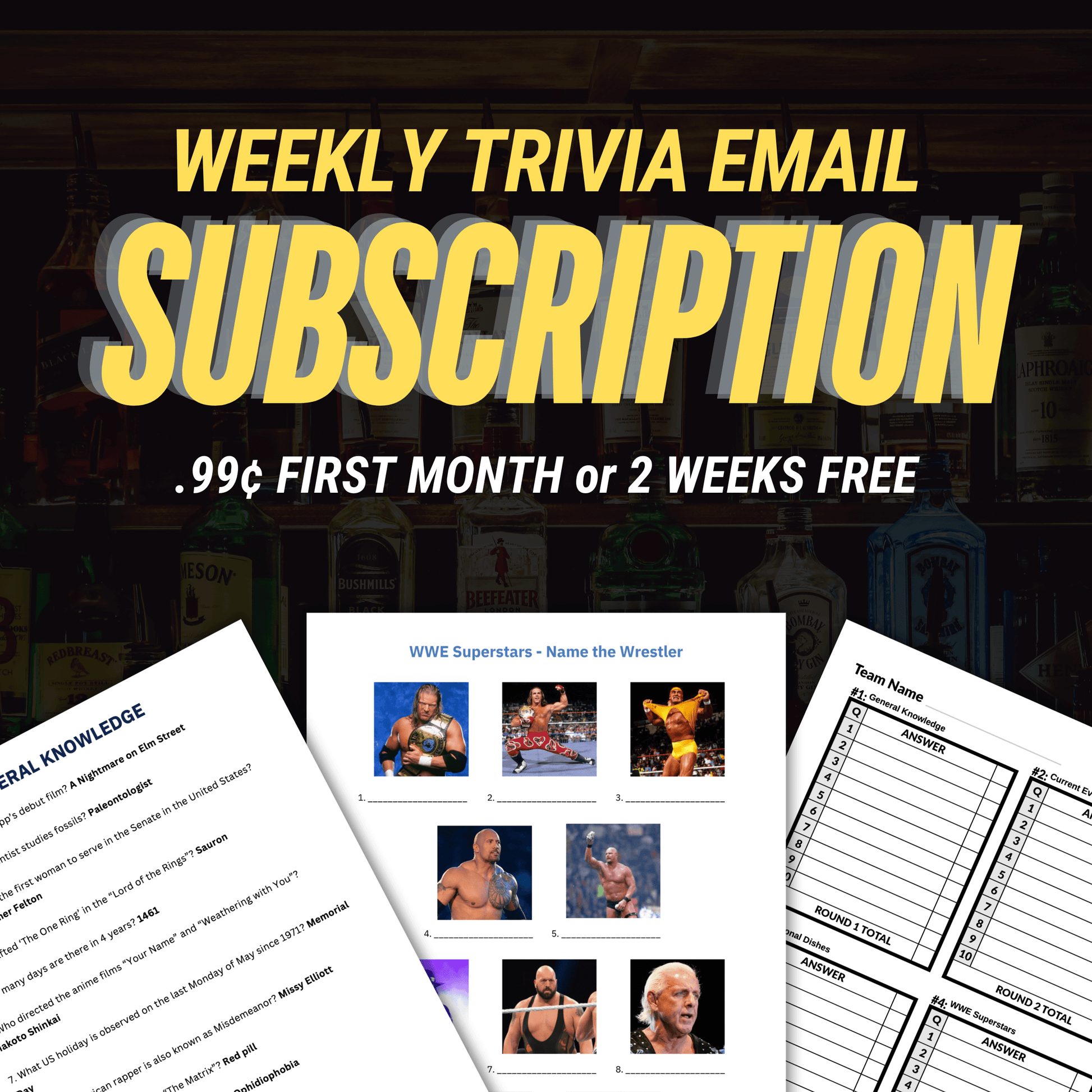
Weekly Trivia Subscription Service
A fresh trivia pack every Monday. Four rounds, 40+ questions, picture round, host script. Built for bars and restaurants who want to run trivia weekly without writing questions themselves.
What the numbers look like at different venue sizes
The 50-seat brewpub above is the median case. Here's what scaling up and down looks like, holding average ticket constant at $29 and headcount lift at 35%.
| Venue size | Trivia headcount | Weekly net lift | Annual net lift |
|---|---|---|---|
| 30-seat neighborhood bar | 22 players | $420 | $21,800 |
| 50-seat brewpub | 38 players | $856 | $44,500 |
| 80-seat sports bar | 56 players | $1,290 | $67,000 |
| 120-seat full-service restaurant | 72 players | $1,710 | $89,000 |
The annual numbers assume 52 weeks. Realistically you'll lose four to six weeks to holidays, NCAA tournaments, and the dead week between Christmas and New Year. Discount accordingly — figure 46 viable Tuesdays.
Reality check: these are mature numbers, not week-one numbers. Month one, expect 8 to 15 players. Month three, expect 20 to 30. Month six is when trivia night earns its line in the P&L. Owners who pull the plug at week six leave $40K on the table.
Costs you have to bake in
Most trivia revenue projections look better than they end up because owners forget the line items below. Bake these in before you start.
- Host fee: $100 to $200 per night for hired hosts in most US markets. $0 if you DIY.
- Question content: $0.99 to $30 per pack from a service like cheaptrivia, or 4 to 6 hours of unpaid writing time per week if you DIY.
- Prizes: $40 to $75 per night. Gift cards, gear, or house bar tabs.
- Sound and projection: one-time $300 to $800 if you don't already have a PA and a TV with HDMI.
- Promotion: $20 to $80 per month in boosted Instagram/Facebook posts. Often skipped, usually a mistake.
Total weekly variable cost for a venue running trivia well: roughly $215 with a hired host, $65 if you self-host. Both are dwarfed by an $850 to $1,700 lift.
How long until trivia night pays for itself?
Two answers depending on whether you DIY or hire.
Self-hosted: first profitable week is usually week one. Total upfront cost is roughly $400 (mic, basic PA, projector adapter) plus $0.99 per week for content. The math goes positive the first night you draw 12+ extra covers.
Hosted by a service: first profitable week is usually week two. The $150 host fee plus $50 prize plus $20 promo means you need a $220 lift just to break even. Most venues clear that on night two and grow from there.
If you're still on the fence after running the math, the question to ask isn't "does trivia work" — the data says yes — it's "do I run it myself or hire a host." That's a different calculation.
Hidden revenue: what doesn't show up in the weekly P&L
The Tuesday-night lift is the easy number to measure. Two more revenue streams take longer to attribute but are real over a year of running trivia consistently.
Repeat-customer halo. Trivia regulars come back on non-trivia nights. A team that plays every Tuesday for six months brings their friends in for a Friday dinner three or four times a year. They become the people who book your back room for a birthday. Estimating that number is fuzzy — venues with mature trivia programs report a 5-12% lift in non-trivia weeknight covers attributable to the trivia regular base.
Private event bookings. Once your trivia night is well-known locally, you'll start getting calls: "Can you host a private trivia night for our office party?" These are typically $400-$800 events on what would otherwise be a Wednesday lunch slow patch. A 50-seat brewpub running successful Tuesday trivia might pick up 8-15 private bookings per year that wouldn't have happened without the trivia reputation. That's another $5,000-$10,000 in incremental revenue per year on top of the Tuesday math.
Add it all together and a mature trivia program at a 50-seat venue contributes $50,000-$60,000 a year in net incremental revenue. Not all from trivia night itself — but all caused by it.
What to track from week one
The owners who treat trivia as a real line in the P&L track a few simple metrics from launch night. The list:
- Headcount: total players plus non-players in the room.
- Average ticket: total food + beverage sales divided by covers, comparing to the same night a month ago.
- Repeat team rate: what percent of teams from week N-1 came back week N. Healthy is above 50% by week 8.
- Bar tab redemption: for venues that prize house tabs — how fast and at what value winners use them. Almost always within 10 days.
- Social engagement: mentions, tags, and check-ins on trivia night. A leading indicator of next week's headcount.
Run those five metrics on a single sheet for 12 weeks. The picture will tell you whether trivia is working long before any single Tuesday confirms it.