Trivia night pricing has three levers: entry, drinks, and food. Most owners pull only the first one, set it wrong, and wonder why the night never grew. The truth is that entry fee is the smallest revenue line on the page. The minimums and bundles attached to it are what move the P&L.
Below is the full model. Every number comes from venues running trivia in the 30-to-150-seat range. The point is not to copy a price — it is to understand what each price does to attendance and net revenue, then pick the combination that fits your room.
Entry fee: free vs paid, and why the answer is almost always paid
The strongest argument for free trivia is friction. The strongest argument against it is the same word. Friction is what you want. People who pay $3 to sit down stay until the final round. People who paid nothing leave at halftime when their team falls behind, and they take their two-drink tab with them.
Three patterns dominate US bar trivia entry pricing right now:
- $0 entry, no minimum: highest top-of-funnel headcount. Worst average ticket, fastest churn, most no-shows. Used by venues that are still scared of trivia.
- $3 per player or $10 per team: the median across the country. Filters out tire-kickers, funds a real prize pool, and signals that the night matters.
- $5 per player: works in dense urban markets, college towns, and at venues with a strong reputation. Headcount drops 15-25% versus $3, but average tab climbs and players are more invested.
One more pricing pattern worth testing: $20 flat per team of up to four. Math-wise it is identical to $5 per player, but psychologically it reads as a friendlier number. A 60-seat tap room in Indianapolis A/B tested per-player vs per-team for six weeks and saw 18% higher signup at $20 per team than $5 per player. Same money, different framing.
What each entry tier actually does to attendance and net revenue
Here is the numbers table. The model assumes a 60-seat venue, four-month-old trivia night, $29 average ticket on trivia night, 30% COGS, and a $150 host fee. Headcount falls as price climbs; average ticket holds steady because the audience self-selects.
| Entry tier | Avg players | Entry revenue | F&B sales | Net contribution |
|---|---|---|---|---|
| $0 entry | 52 | $0 | $1,508 | $806 |
| $3 per player | 44 | $132 | $1,276 | $793 |
| $5 per player | 36 | $180 | $1,044 | $636 |
| $20 per team of 4 | 40 | $200 | $1,160 | $732 |
Two things stand out. First, $0 and $3 produce nearly identical net contribution — the entry fee at $3 just shifts a few dollars from the F&B column to the entry column. Second, $5 per player is where the math starts to bend. You lose enough headcount that the higher entry can't make it up, unless your prize pool is so good it pulls a different demographic.
The reason $3 wins: it gives the prize pool real money without scaring off the casual player. A 44-player room with $132 in entry can hand out a $100 first-place house tab, $30 second-place gift card, and $20 in shots for the picture-round winner. That feels like a real prize. A $0 prize pool feels like a hobby.
Drink minimum policies: the lever owners forget
An entry fee charges 40 people once. A drink minimum nudges 40 people to order a second beer. The second one is bigger.
Three drink-minimum patterns work in trivia:
- One-drink-minimum-to-play: standard at most paid-host trivia leagues. Feels mandatory, drives a guaranteed first round, easy for staff to enforce.
- Two-drink minimum across the night: not enforced as a pour count, but signaled in marketing. Adds about $6-9 per cover when paired with $3 entry.
- No minimum, but house specials: $5 draft beer, $7 well cocktail, $9 trivia shot. Volume beats margin on a night you would otherwise be losing money on.
The third option is the most common at venues that built strong trivia programs. House specials are what take a $20 average tab to $29. Players see "trivia night $5 drafts" on the chalkboard, order a third one because it feels cheap, and the venue still grosses more on volume than it would charging $7 standard pricing to a smaller crowd.
One warning: do not put trivia drink specials on bottom-shelf liquor. Trivia regulars will notice within two weeks, and the night will get a reputation. Run specials on a quality well or a local craft draft instead.
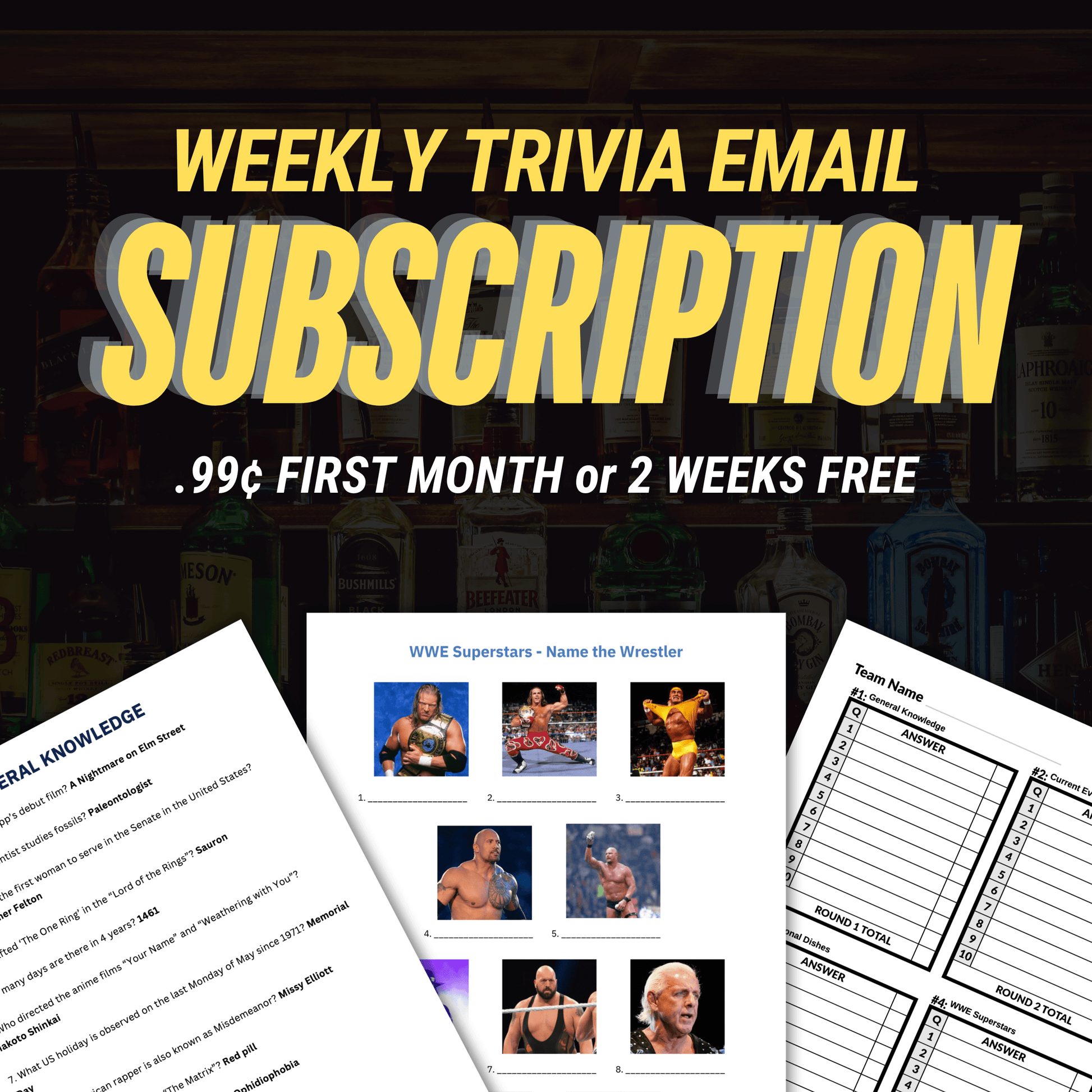
Weekly Trivia Subscription Service
Pricing strategy works only if the night is good enough that players come back. A fresh pack each Monday with 4 rounds, a picture round, and a host script ensures the content side never lets you down.
Food bundles: where margin actually lives
Drinks fund the bar. Food funds the rest. Trivia night is the single best opportunity to push appetizer bundles and shareable plates because teams of four already split everything by default.
The food pricing patterns that work:
- Trivia team platter, $32 to $45. Wings, fries, sliders, dip. Sized for four. Margin on shareable food is typically 65-72% — significantly higher than entree margin. A 60-seat room running ten teams ordering platters at $38 generates $380 in food before single orders.
- Halftime two-fer: any appetizer plus a pitcher for $26. Pushed during the 15-minute break between rounds two and three. Captures the crowd that would otherwise nurse one drink.
- Round-2 kitchen call: last-call announcement at 7:55pm gives the kitchen runway to clear before the night ends. Often worth $200-300 in food sales that would otherwise leak.
A 50-seat brewpub in central Texas added a $36 trivia platter to its Tuesday board four months in and watched average ticket climb from $24 to $31 within three weeks. The food cost on the platter ran 28%. Net contribution per Tuesday rose roughly $280 from food alone.
Putting the three levers together
The default starting recipe for a venue with no trivia history: $3 per player, no drink minimum, one trivia food bundle on the chalkboard, $5 draft and $7 well specials. Run that for six weeks before changing anything. It produces enough headcount to learn what your room actually does, without taxing the night with too many rules.
After six weeks, you will know:
- Whether headcount is climbing week over week (it should, by 5-10% per week early on)
- What the average tab actually is, broken out from baseline Tuesday
- Which food items are pulling on trivia night vs sitting
- How many teams are repeat by week six (target: at least 50%)
From there, you can raise entry to $5 if your room is full, add a drink minimum if margin is suffering, or expand the food menu if the kitchen has runway.
Mistakes to avoid in trivia night pricing
The four pricing mistakes that consistently hurt trivia revenue:
- Free entry with no prize. Free trivia with no prize pool tells the room you do not care. Players follow your lead. Either charge $3 and use it as the prize, or pay for the prize out of food margin.
- Charging $10 per player. $10 per player works at branded multi-bar leagues with TV rights and big cash prizes. It does not work for an independent venue running trivia for the first time. You will not draw enough volume to cover host and prize costs.
- Drink minimums no one is told about. If you want a minimum, write it on the chalkboard and have the host announce it. Servers asking "do you have your drinks yet?" mid-game feels like a parking ticket and kills the mood.
- Premium-priced food bundles. A $58 trivia platter feels like a markup. A $36 one feels like a deal. Pricing food bundles right at or just below the cost of buying the same items separately drives volume.
What changes by venue type
Three quick variants by room style. The basic recipe holds; the prices flex.
- Brewpub or taproom: $3 entry, no minimum, $14 wing-and-flight bundle. Beer is the draw, food is incremental.
- Full-service restaurant: $5 entry per player, prix fixe trivia menu at $24, half-off appetizers during halftime. Higher margin but lower volume than a pure bar.
- Dive or sports bar: $20 per team of 4, $4 draft specials all night, no food bundle but a 25-cent wing call between rounds. Volume play.
The lever that scales hardest with venue type is food. A taproom does not need a food bundle to win on trivia night. A full-service restaurant lives or dies by the prix fixe attach rate.
Bottom line: where to set your prices on opening night
If you are launching trivia for the first time, set entry at $3 per player, run two drink specials at trivia-only prices, and put one food bundle on the chalkboard. That combination produces the best signal-to-noise ratio for the first six weeks — enough headcount to learn what your room does, enough revenue to cover the host and prize costs, and enough simplicity that staff can actually execute on a Tuesday evening.
Once the night stabilizes around 35 to 50 players, revisit pricing. Until then, simpler beats clever, and consistent beats experimental.