If you are an HR manager, an executive assistant, or an event coordinator pricing out a trivia night for a company event, the market gets confusing fast. Quotes range from $400 for a freelance host with a Bluetooth speaker to $2,000 for a national vendor with custom-branded slides. Both can deliver a great night. Both can also fail.
This page is the buyer's-side guide. What each price tier actually buys, what to ask before signing, what format works for which group size, and when running it yourself with a purchased pack saves $1,500 and produces an equally good event.
The corporate trivia pricing tiers, demystified
Corporate trivia pricing breaks cleanly into four tiers. Vendors usually slot into one of them, and the differences are mostly about polish, scale, and how much customization you get.
| Tier | Price range | Group size | What you get |
|---|---|---|---|
| DIY with pack | $15-$80 | Any size | Pack with questions, slides, host script. You provide the host. |
| Freelance host | $400-$700 | 15-50 | Live host, mic, basic slide deck. Limited custom content. |
| Mid-market vendor | $700-$1,200 | 30-100 | Branded slides, two custom rounds, light tech setup. |
| National / agency | $1,200-$2,000+ | 50-300+ | Full branding, custom rounds about the company, A/V production, multiple emcees. |
The tier that fits depends on three things: group size, how branded you need it to feel, and whether the event is a primary entertainment block or a side activity. A 25-person team-building lunch is a different problem than a 200-person holiday gala.
What each tier actually delivers (and where the gaps are)
DIY with a purchased pack ($15 to $80). Works for groups under 60 where someone internal — usually an outgoing team lead or the EA — is willing to host. You buy a print-and-project pack, run it yourself in a conference room or restaurant private room, and hand out gift cards. The night feels homemade, which is fine for a regular team lunch and inappropriate for a holiday party.
Freelance host ($400 to $700). A working trivia host, often someone who runs weekly bar nights, brings their pack, mic, and laptop. They pull from a generic question library or run a popular theme. Custom content beyond "we hear Mike got married last weekend" is rare at this tier. Best for casual team events of 20 to 50 people in a private dining room or office space.
Mid-market vendor ($700 to $1,200). A small trivia company with branded slide templates, two or three custom round options, and a polished host. They will typically ask for a few company facts beforehand and weave them into a "Round 4: Know Your Coworkers" section. The slides match your event aesthetic. This is the most common tier for company holiday parties and 50-to-100-person offsites.
National or agency tier ($1,200 to $2,000+). Full A/V production, multiple emcees if needed, fully custom rounds about the company's history or product, branded leaderboards, sometimes prize fulfillment. Justified for kickoffs, sales summits, or large-format events where trivia is the primary entertainment block. A 220-person sales kickoff in San Diego paid $1,850 for a vendor with two emcees, a video round featuring CEO clips, and team scoring on a giant projection — and reported it as the highest-rated session of the three-day program.
Format expectations for corporate trivia
Corporate trivia is shorter and friendlier than bar trivia. The room has a wider age range, multiple second-language speakers, and people who would rather lose than embarrass themselves. Format calibration matters more than question quality.
The format that works best for most corporate events:
- 60-75 minute total runtime for groups under 100. Longer than 90 minutes and engagement drops sharply.
- 4 rounds of 8 questions each instead of the bar standard 4x10. Tightens the show.
- Easier difficulty than bar trivia. Aim for a 75% average score, not the 60% that defines a competitive bar quiz.
- One picture or "know your coworkers" round. Photo IDs of execs, company milestones, or product easter eggs. This is what people remember.
- Team size of 4 to 6. Larger teams prevent quieter colleagues from feeling on the spot.
- Light prizes. Branded swag, gift cards in the $25 to $75 range, an extra PTO day. Cash prizes feel weird at corporate events.
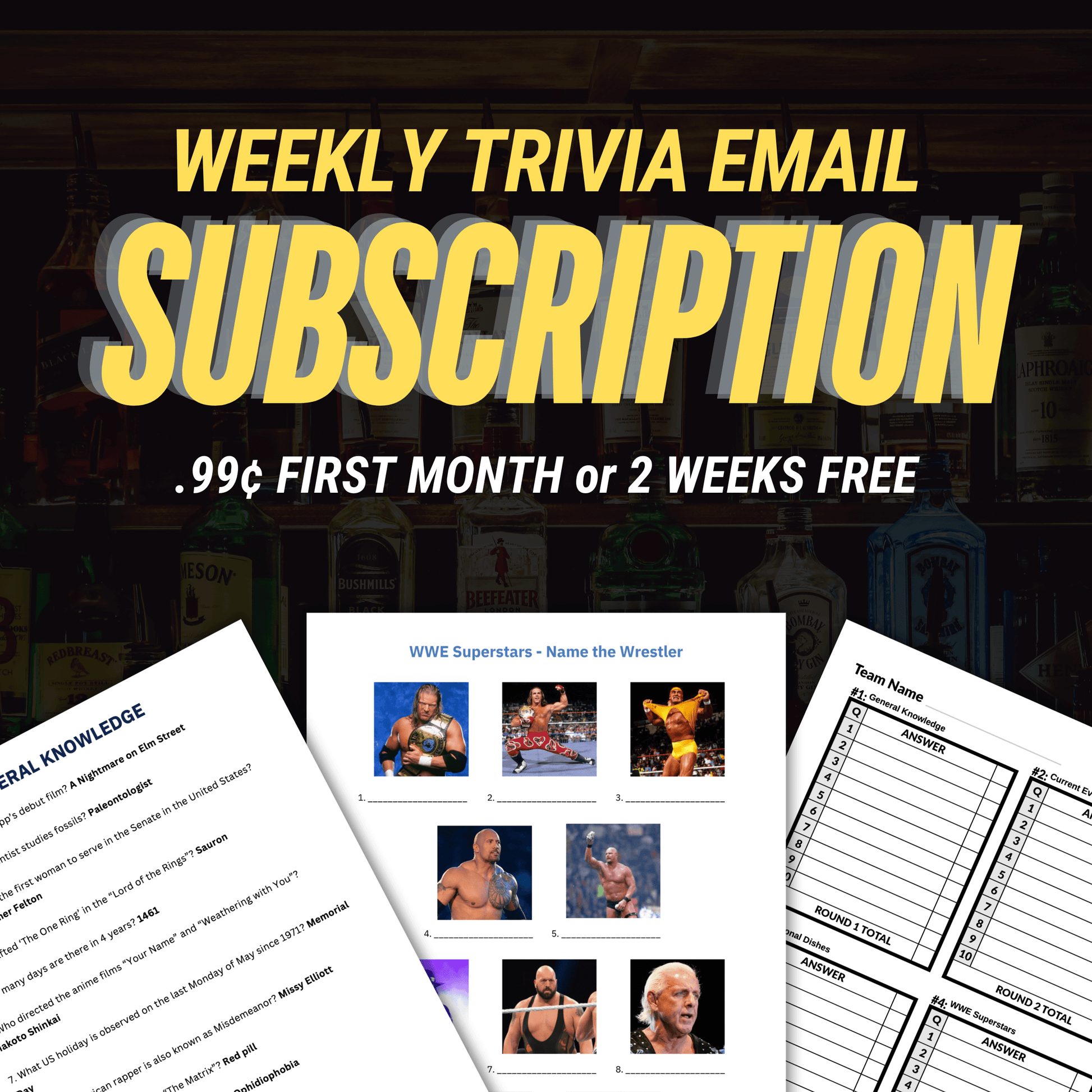
Weekly Trivia Subscription Service
Running a corporate trivia event yourself? A professional pack with 4 rounds, a picture round, and printable host script costs less than a dinner-for-two and replaces 6+ hours of writing time. The print-and-project setup works in any conference room.
What to ask any vendor before you sign
The corporate trivia market has wide quality variance because there is no professional certification. The questions below filter out the weak vendors and help you align expectations with the polished ones.
- How many corporate events have you hosted in the past 12 months? A vendor running 30+ corporate events per year has the rhythm dialed in. Fewer than 6 means you are paying for their learning curve.
- Can you customize a round for our company, and what does that include? "Yes" should mean a Round 4 written specifically about your team. Probe for what data they need from you and how far in advance.
- What does your tech setup require? A good vendor brings everything — mic, speakers, laptop, HDMI/USB-C, slide remote. Beware vendors who ask the venue to provide A/V; that is where most events go sideways.
- What is your contingency if the projector or audio fails? The right answer is a printable backup pack and a portable Bluetooth speaker in the trunk.
- What happens if our headcount changes 48 hours out? Some vendors lock in pricing tiers; others flex. Know before signing.
- Who is the actual host on the night? Smaller vendors send the owner. Larger ones may send a contractor you have never spoken to. Both can be great; you just need to know.
- What is the cancellation and reschedule policy? Standard is a 30% non-refundable deposit, full refund minus deposit if canceled 14+ days out.
When DIY beats hiring a vendor
DIY does not mean cheaping out. It means recognizing when the moneysaver is also the better night. Three scenarios where DIY genuinely wins:
- Internal team-building lunches under 25 people. Hiring a vendor for a small group feels like overkill, and a colleague hosting builds more team rapport than a stranger doing it.
- Recurring quarterly events. If you run trivia every quarter, paying $700-$1,200 four times a year is $3,000-$5,000. A weekly subscription is under $100 a year. The savings buy the prizes.
- Tightly themed events. If your event is "Holiday Party with Christmas Trivia," a themed pack written specifically for the holiday gives you better content than a generalist vendor adapting on the fly.
The DIY tradeoff is hosting capacity. You need someone internal who is comfortable on a microphone for 60 minutes and willing to enforce timing. About one in eight teams have that person; the other seven should hire.
Pricing benchmarks by event size
Median pricing across mid-market US vendors for common corporate event sizes. Use this as a sanity check on quotes you receive.
| Event size | Typical price | Vendor tier that fits | Per-head cost |
|---|---|---|---|
| 15-25 people | $400-$650 | Freelance host or DIY | $16-$26 |
| 30-50 people | $650-$950 | Freelance or mid-market | $13-$22 |
| 50-100 people | $950-$1,400 | Mid-market vendor | $10-$19 |
| 100-200 people | $1,400-$1,900 | Mid-market or national | $9-$14 |
| 200+ people | $1,900-$3,000 | National / agency | $8-$12 |
Note that per-head cost falls as size grows. If your boss is questioning a $1,500 quote for 120 people, that is $12.50 per head — cheaper than a coffee for everyone in the room.
The four mistakes that ruin corporate trivia events
Even good vendors and good packs can fail when the event itself is poorly framed. Avoid:
- Booking the trivia after a heavy speaker block. A 90-minute strategy session followed by 75 minutes of trivia kills energy. Trivia goes first or after a real break.
- Mandatory team assignment. Forcing employees onto random teams reads as forced fun. Let people self-select with a soft cap of 6 per team.
- Questions that mock employees. "Round 5: What did Brian wear to last year's party?" is a lawsuit waiting. Custom rounds should celebrate, never roast.
- No clear winner moment. Skipping the prize ceremony to keep things on schedule is the most common ending failure. Budget five minutes at the end for the photo, the handoff, and the laugh.
What good looks like
A successful corporate trivia event runs 60-75 minutes, ends 5-10 minutes early, has at least one moment where an unexpected team or quiet employee wins, includes a custom round that makes the room laugh in recognition, and produces a photo of the winning team for the company Slack the next morning. If you booked a vendor and got that, you got your money's worth. If you ran it yourself with a $30 pack and got that, you saved $1,200 and probably built more team rapport than a stranger ever could.
The thing that makes corporate trivia work is the same thing that makes bar trivia work: respect for the audience, a tight format, and content that lets the room win together. Pricing and vendor tier are just the wrapper around those fundamentals.