Bar trivia looks low-risk because it is. Almost every bar in America runs it without incident. But every year a small number of venues get fined, sued, or have a license reviewed because of trivia-night decisions that seemed harmless — an audio round of copyrighted songs, a $500 cash prize advertised on Instagram, an unspecified disclaimer about alcohol service.
This page is the practical legal checklist. It is not legal advice and does not replace your attorney. It does cover the four areas where bar trivia liability actually shows up: prize legality, music licensing, social media disclosure, and alcohol service implications.
Prize legality: where cash gets you in trouble
The legal question is whether your trivia-night prize is a "lottery." Most states define a lottery as having three elements: prize, chance, and consideration (a fee or purchase to participate). Eliminate any one of the three and you are not running a lottery.
The element trivia hosts almost always trip on is "consideration." Charging $5 to enter a trivia event with a cash grand prize can technically constitute a regulated lottery in some states, even though the contest is skill-based. State laws vary widely on whether trivia counts as "skill" or "chance" for these purposes, and whether bar promotions are exempt.
| Prize structure | Risk level | Why |
|---|---|---|
| House bar tab / gift card | Low | Not cash; redeemed at the venue |
| Branded swag, merch, or food | Low | In-kind prize, low ambiguity |
| Cash, no entry fee | Low to medium | No "consideration" element |
| Cash, entry fee that funds prize | Medium to high | Looks like a regulated raffle/lottery in many states |
| "Buy a drink to play" with cash prize | Medium | Drink purchase can count as consideration |
The cleanest setup almost everywhere: prizes are bar tabs, gift cards, or in-kind items. Entry fees are reasonable ($3 to $5) and treated as a registration fee, not directly bundled into a cash prize pool. If you want to run a cash-prize structure, ask your state's gaming commission or alcohol board first — some states have explicit "tavern game" or "amusement contest" exemptions for skill-based bar contests, and others do not.
One state-level pattern worth noting: a 90-seat sports bar in Ohio ran a $500 monthly cash trivia jackpot for a year, then had its liquor license reviewed because the local commission classified it as an unlicensed gaming activity. The fix was switching to a bar-tab grand prize and naming the event a "trivia tournament" rather than a "jackpot." No fine, but a real scare.
Raffle vs trivia: the line that matters
A raffle has random selection. A trivia contest has skill-based outcome. That distinction is the legal anchor that protects most bar trivia from being regulated as a lottery. Three rules to keep your night clearly on the trivia side:
- Award based on score, not random draw. Tiebreakers should be skill-based (closest-without-going-over numerical question, sudden-death question), not coin flips.
- Do not award random door prizes funded by entry fees. "Everyone who paid $5 is entered to win a TV" is structurally a raffle and may require a state raffle license, often restricted to nonprofits.
- Document your scoring. Keep score sheets for at least 30 days. If anyone questions whether the night is skill-based, that paper trail is your defense.
Music licensing: where audio rounds get expensive
The single most common legal issue at bar trivia is unlicensed music in audio rounds. Playing a 10-second clip of a song to ask "who recorded this?" is a public performance under US copyright law. If your bar already has an ASCAP, BMI, and SESAC blanket license — most do — you are usually covered. If you do not, you are exposed.
The three main performance rights organizations and what they typically charge a small bar:
- ASCAP: covers ~1.1 million songs. Small bar annual rate roughly $400-$1,200 depending on capacity and entertainment level.
- BMI: covers ~22.4 million songs. Similar pricing range, separate license.
- SESAC: smaller catalog but includes major artists. $300-$700 typical small-bar range.
Most US bars hold all three because the catalogs do not overlap. If you only have one or two licenses, you are still exposed for the artists not represented. PROs (performance rights organizations) routinely send investigators to bars; the typical settlement when caught unlicensed is $1,500 to $25,000 depending on the violation.
Practical implications for trivia:
- Audio rounds should be cleared by your existing PRO licenses. Verify which PROs you have.
- Picture rounds using album art, movie posters, or copyrighted images are typically fine under fair-use doctrine for educational/identification purposes, but the law is fuzzy. Original photographs of public landmarks, generic objects, or properly licensed stock images are safer.
- Music videos played for an audio round require both performance and synchronization rights — the latter not covered by ASCAP/BMI/SESAC blanket licenses. Stick to audio-only clips for audio rounds.
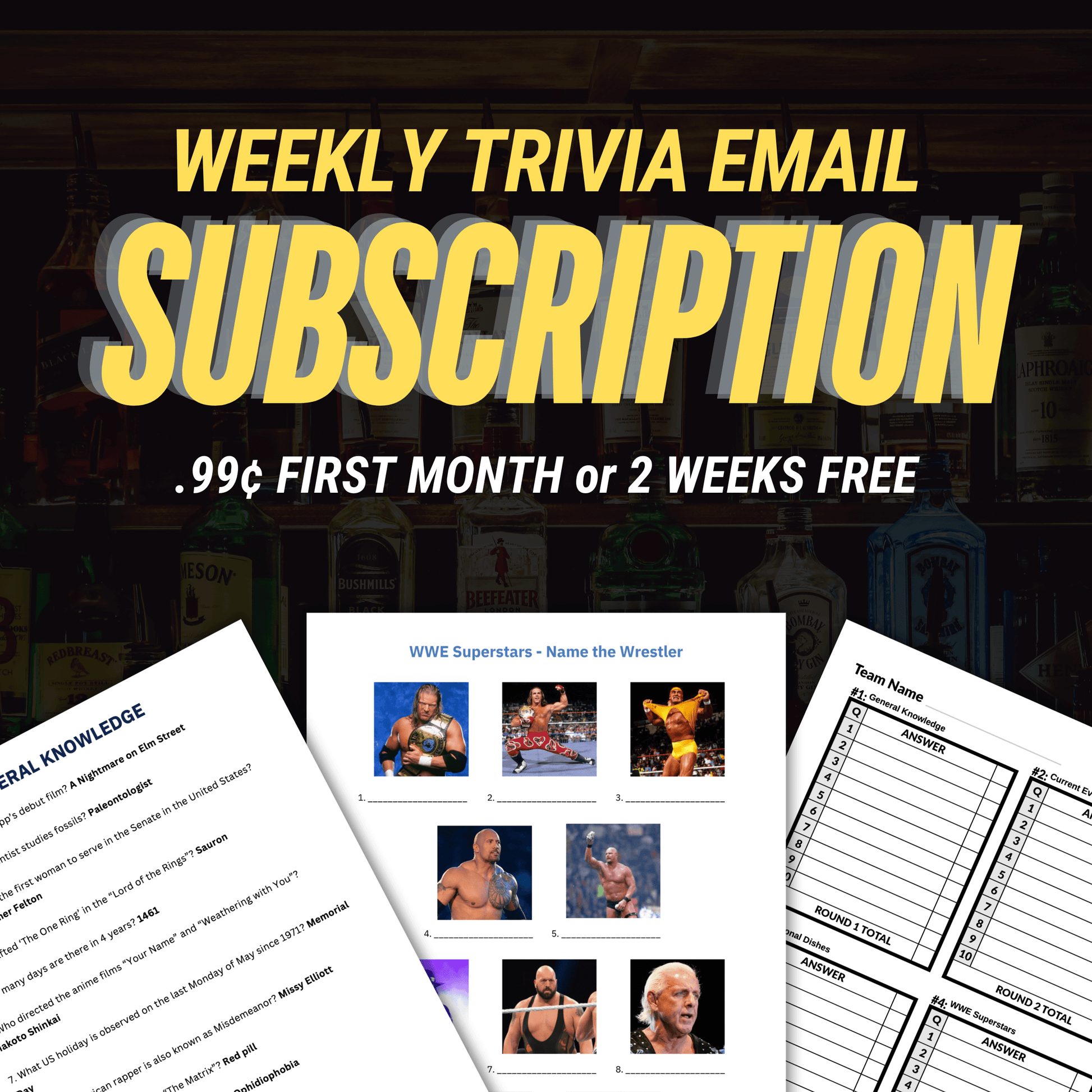
Weekly Trivia Subscription Service
Themed trivia packs that ship with commercial-licensed picture rounds and host scripts. Built for bar and restaurant use, including the licensing assumptions baked into the format. No hassle on the content side.
Social media disclaimers: the under-disclosed risk
Promoting trivia night on Instagram and Facebook is standard. What most venues miss: any prize promotion advertised on social media may be subject to platform-specific contest rules and applicable state advertising regulations.
Three disclosures that go on every social post promoting a trivia night with prizes:
- "No purchase necessary." Where state law allows, signal that participation is open to anyone, not contingent on buying a drink. Even if your bar requires entry fees, "no purchase necessary" with an alternative free entry path is the legally safer framing.
- "Must be 21+ to play (or to win prizes including alcohol)." Age restrictions for venues with alcohol service must be visible on promotional content.
- "This promotion is not sponsored, endorsed, or administered by Instagram/Meta." Required by Meta's promotional guidelines for any contest run on the platform.
The safest pattern is a one-line disclaimer at the bottom of any post advertising a prize. "Trivia Tuesday | 7pm | $50 bar tab to first place | Must be 21+ | Not sponsored by Meta." Almost no one will read it. The point is that it exists if anyone looks.
Alcohol service implications
Trivia night runs longer and pulls bigger crowds than a normal slow Tuesday. Two alcohol-service issues that matter:
Last call timing. If trivia runs until 9pm and your kitchen closes at 9:30pm, players will press for "one more" after the prize ceremony. Train staff on the same last-call discipline they would use any other night. Server liability for over-service does not relax because the night was an event.
Designated driver protocols. Trivia regulars often arrive in groups of four, drink steadily for 2.5 hours, and leave together. The risk of someone driving impaired is statistically higher than at a typical Tuesday because the dwell time is longer. Most well-run trivia programs offer free non-alcoholic drinks for designated drivers as a standard feature, and post the rideshare promo codes near the door. This is good operations and good legal hygiene.
If your state has happy-hour restrictions, check whether trivia drink specials trigger them. Some states limit deeply discounted drink specials to specific time windows and prohibit their advertisement. A "trivia night $5 draft" promoted online may need to comply with those rules.
The bar trivia legal checklist
Run this list before launch and once per year. None of it takes more than a Saturday afternoon to verify.
- Confirm ASCAP, BMI, and SESAC licenses are current. Your accountant likely has records.
- Confirm your liquor license has no language restricting "amusement gambling" or "games of chance." If it does, talk to a local attorney before launching.
- Default prizes to bar tabs, gift cards, and in-kind items. Avoid cash prizes funded directly by entry fees.
- Add the "No purchase necessary," "21+," and "Not sponsored by Meta" lines to every social post advertising prizes.
- Document scoring with retained score sheets for 30 days.
- Train staff on the same last-call protocols used on any non-trivia night.
- If you advertise drink specials, verify they comply with your state's happy-hour rules.
- Confirm picture rounds use commercial-licensed or fair-use-clear images. Generic, original, or vendor-supplied images carry the lowest risk.
None of this should make you nervous about running trivia. It is a low-friction, profitable weeknight play for almost every bar. The point of the checklist is that the few things that can go wrong are predictable and avoidable, and 90 minutes of administrative work upfront keeps the night from ever showing up on your liquor commission's desk.